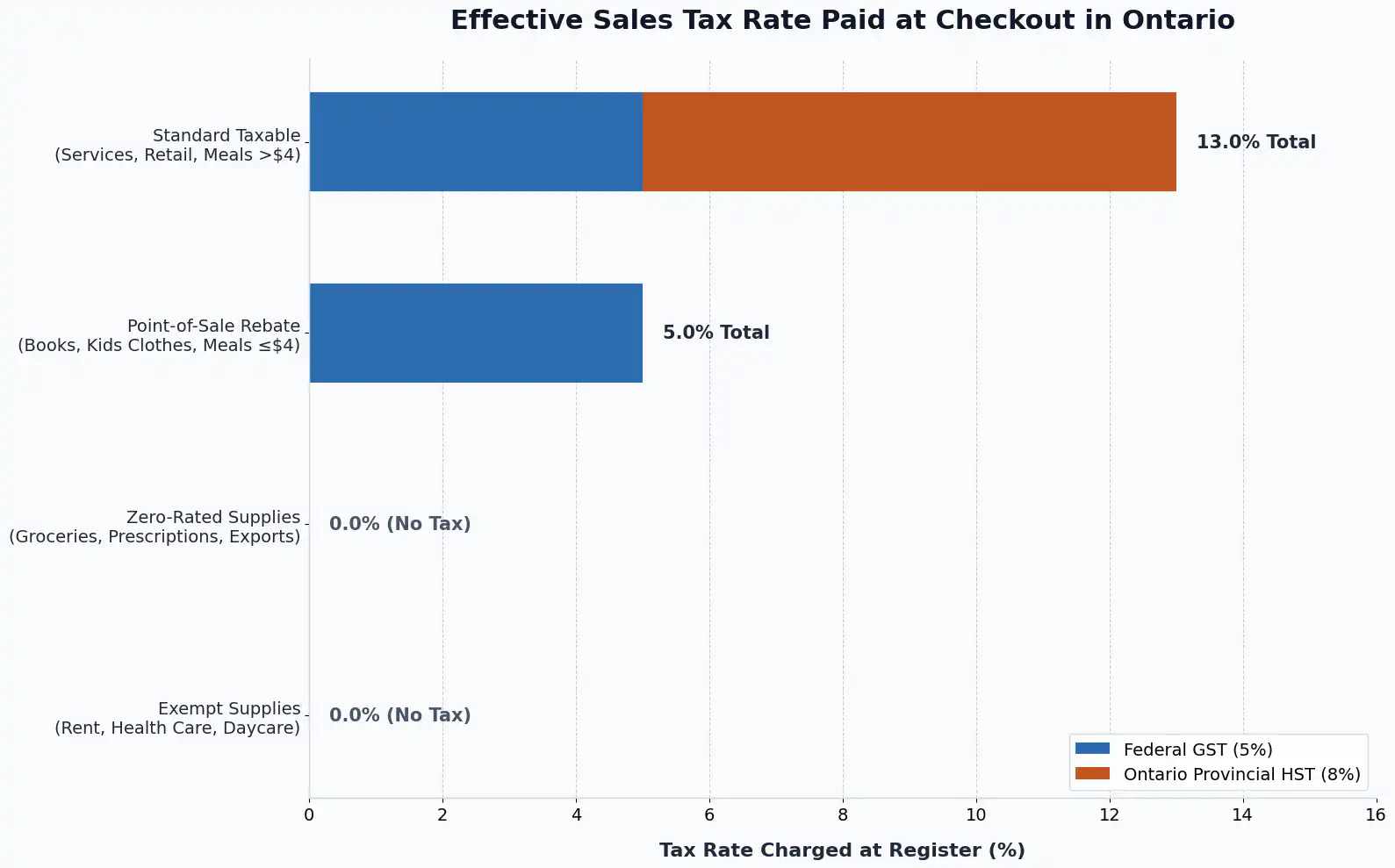
Ontario HST exemptions are often confused with two other treatments: exempt supplies carry no HST (such as long-term residential rent, most health and dental services, child care and most financial services); zero-rated supplies such as basic groceries, prescription drugs and medical devices are taxed at 0%; and taxable items eligible for a point-of-sale rebate of the 8% provincial portion, such as children’s clothing, diapers, car seats, printed books and qualifying prepared food totalling $4 or less before tax, carry only the 5% federal part. Ontario’s standard harmonized sales tax is 13%: a 5% federal part and an 8% provincial part. Some supplies are exempt, some are taxable at 0%, and some qualifying purchases receive a point-of-sale rebate of the 8% provincial part. These categories can look similar at checkout but have different consequences for a seller’s input tax credits (ITCs). The guidance below was checked on October 16, 2026. CRA rates.
Ontario introduced HST on July 1, 2010. This page retains its historical address, but the examples below use current rules rather than the original transition-era list. For the general rate and registration overview, see HST in Ontario.
| Treatment | What the customer generally pays | What it means to the seller |
|---|---|---|
| Taxable at 13% | Full applicable HST | A registrant may claim eligible ITCs for commercial inputs, subject to the rules. |
| Zero-rated | 0% HST | The supply is taxable; related eligible ITCs may be available. |
| Exempt | No HST charged | Generally no ITCs for inputs used to make exempt supplies. |
| Qualifying point-of-sale rebate | The 8% provincial part is credited, leaving the 5% federal part | The supply remains taxable; a qualifying seller accounts for the rebate under CRA rules. |
See the CRA’s registrant guide for the distinction and ITC conditions. None of the categories means every purchase by a particular person is exempt.
Ontario HST exemptions list: exempt and zero-rated items
Examples of exempt supplies include:
- Most long-term residential rent.
- Many health and dental services that meet the statutory conditions.
- Qualifying child care.
- Many financial services.
- Qualifying tutoring, in some circumstances.
The details matter: not every clinic service, educational service or bank fee has the same classification. Tutoring can be exempt in qualifying circumstances; do not treat all private lessons as automatically taxable or exempt. Exempt supplies are also not taxable supplies for the federal small-supplier threshold. That threshold is generally $30,000 in worldwide taxable supplies, including zero-rated supplies, of the business and its associates. Check the exact supply and provider against the CRA’s exempt supplies guidance and CRA’s registration rules, or see our GST/HST small-supplier threshold page.
Examples of zero-rated supplies include:
- Basic groceries.
- Qualifying prescription drugs and dispensing fees.
- Some medical devices, such as hearing aids, wheelchairs and prescription eyeglasses.
- Feminine hygiene products.
- Exports of most goods and services to customers outside Canada.
A zero-rated grocery is not the same as prepared food that qualifies for an 8% rebate (below). An eligible registered business may claim ITCs on qualifying purchases used in zero-rated commercial activities, but must retain supporting documents and apply the applicable business-use rules. For mixed exempt and taxable activities, allocate inputs appropriately instead of claiming the whole amount by default. CRA registrant guide. For the general federal rules behind these categories, see our exempt vs zero-rated supplies explainer.
What groceries are taxed in Ontario?
Basic groceries — milk, cheese, butter, eggs, fresh fruit and vegetables, meat and flour — are zero-rated and carry no HST. Snack foods, candy, carbonated drinks and most prepared or restaurant food are generally taxed at the full 13%, except qualifying prepared food and beverages ready for immediate consumption when the pre-tax total of all qualifying items sold to a person at one time is $4 or less; these qualify for the 8% point-of-sale rebate instead (see below). Some baked goods, such as packaged cookies, can fall on either side of the line depending on the package size and point of sale, so check the specific product against the CRA’s basic groceries guidance rather than assuming. Non-food household items sold in a grocery store, such as paper towels, are taxed at 13% like any other taxable retail good.
Ontario’s 8% point-of-sale rebate
For certain goods, a supplier credits the provincial part of HST at the point of sale. The following list is subject to CRA definitions and exclusions:
- Qualifying printed books, audio recordings of printed books and printed religious scriptures. E-books do not qualify as printed books. Some magazines and other periodicals purchased by subscription can qualify when no more than 5% of the total printed space is advertising; per-copy purchases do not qualify under this book rule. CRA: point-of-sale rebate on books.
- Qualifying children’s clothing and footwear, diapers, and car seats or booster seats. The clothing and footwear rules use specific size and design criteria; adult-sized clothing bought for a child and footwear used exclusively for sport do not qualify under those categories.
- Qualifying printed newspapers.
- Qualifying prepared food and beverages ready for immediate consumption, when the total price, excluding HST, of all qualifying items sold to a person at one time is $4 or less. Only qualifying food and beverages count toward this test when qualifying and non-qualifying items are purchased together; alcohol is excluded.
The detailed conditions and additional category-specific rules are in the CRA point-of-sale rebate guide.
Example: A qualifying prepared sandwich costs $4 before tax. HST at 13% is $0.52; the 8% rebate is $0.32. The customer pays $4.20. This is a taxable supply with a rebate, not an exempt supply. If a qualifying meal costs $4.01 and no other special treatment applies, it exceeds the rebate limit and 13% HST is $0.52 after rounding, for $4.53.
If the seller charged the full 13% on an eligible item, ask about a correction and keep the receipt. CRA also describes a reason-code 16 rebate application and its conditions; the same amount cannot be recovered twice through a rebate, refund or ITC. CRA eligibility and claim conditions.
Newly built or substantially renovated homes are not exempt; the full HST generally applies on the purchase price, but a buyer may qualify for the federal GST/HST new housing rebate and Ontario’s new housing rebate on part of the tax paid. See our Ontario new housing HST rebate page for the thresholds and conditions. Digital products and software as a service (SaaS) sold to Ontario consumers are generally taxable at 13%, not exempt or zero-rated; see the CRA’s digital economy GST/HST guidance.
Ontario PST exemption certificate: does it still exist?
There is no general Ontario PST exemption for ordinary purchases since HST replaced RST on July 1, 2010. But Ontario retail sales tax (RST) still applies to certain insurance and benefit-plan premiums and specified private vehicle transactions. A limited Purchase Exemption Certificate can support a qualifying RST exemption on certain insurance contracts or benefit plans. For example, qualifying agricultural property insurance requires the statutory conditions to be met; a properly completed certificate or accepted identity card may be required. The province explains remaining RST and the insurance certificate rules. RST on specified private vehicles and boats bought privately in Ontario is covered on our Ontario RST on private vehicles and boats page.
A GST/HST registration number is not a general substitute for an Ontario RST exemption certificate. Similarly, purchasing goods for resale does not make an ordinary HST-taxable sale automatically tax-free; an eligible registrant may instead recover qualifying tax through an ITC.